Maxime Ripard introduces two new clock providers into RPi4's device tree:

- The first one based on the enhancements made to clk-raspberrypi, which
  is now registered trough DT and provides control over the whole range
  of firmware based clocks.

- The second one based on the new clk-bcm2711-dvp driver, which gates
  the clocks and reset signals that feed into RPi4's HDMI0/1 blocks.

Signed-off-by: Florian Fainelli <f.fainelli@gmail.com>
Fix dtschema validator warnings like:
    l2-cache@22000: $nodename:0:
        'l2-cache@22000' does not match '^(cache-controller|cpu)(@[0-9a-f,]+)*$'

Signed-off-by: Krzysztof Kozlowski <krzk@kernel.org>
Acked-by: Scott Branden <scott.branden@broadcom.com>
Signed-off-by: Florian Fainelli <f.fainelli@gmail.com>
All those devices use standard BCM53011 (rev 5) or BCM53012 (rev 0).

Signed-off-by: Rafał Miłecki <rafal@milecki.pl>
Signed-off-by: Florian Fainelli <f.fainelli@gmail.com>
Some Makefiles already pass -fno-stack-protector unconditionally.
For example, arch/arm64/kernel/vdso/Makefile, arch/x86/xen/Makefile.

No problem report so far about hard-coding this option. So, we can
assume all supported compilers know -fno-stack-protector.

GCC 4.8 and Clang support this option (https://godbolt.org/z/_HDGzN)

Get rid of cc-option from -fno-stack-protector.

Remove CONFIG_CC_HAS_STACKPROTECTOR_NONE, which is always 'y'.

Note:
arch/mips/vdso/Makefile adds -fno-stack-protector twice, first
unconditionally, and second conditionally. I removed the second one.

Signed-off-by: Masahiro Yamada <masahiroy@kernel.org>
Reviewed-by: Kees Cook <keescook@chromium.org>
Acked-by: Ard Biesheuvel <ardb@kernel.org>
Reviewed-by: Nick Desaulniers <ndesaulniers@google.com>
The hardware codec on the A10, A10s, A13 and A20 needs buffer in the
first 256MB of RAM. This was solved by setting the CMA pool at a fixed
address in that range.

However, in recent kernels there's something else that comes in and
reserve some range that end up conflicting with our default pool
requirement, and thus makes its reservation fail.

The video codec will then use buffers from the usual default pool,
outside of the range it can access, and will fail to decode anything.

Since we're only concerned about that 256MB, we can however relax the
allocation to just specify the range that's allowed, and not try to
enforce a specific address.

Fixes: 5949bc5602 ("ARM: dts: sun4i-a10: Add Video Engine and reserved memory nodes")
Fixes: 9604320101 ("ARM: dts: sun5i: Add Video Engine and reserved memory nodes")
Fixes: c2a641a748 ("ARM: dts: sun7i-a20: Add Video Engine and reserved memory nodes")
Signed-off-by: Maxime Ripard <maxime@cerno.tech>
Acked-by: Chen-Yu Tsai <wens@csie.org>
Link: https://lore.kernel.org/r/20200704130829.34297-1-maxime@cerno.tech
Remove the regulators node entirely because its children do not have any
unit addresses.  This fixes DTC warning:

    Warning (simple_bus_reg): /regulators/regulator-0: missing or empty reg/ranges property

Signed-off-by: Krzysztof Kozlowski <krzk@kernel.org>
Tested-by: Marek Szyprowski <m.szyprowski@samsung.com>
Instead, expose the key via the input framework, as SW_MACHINE_COVER

The chip-detect GPIO is actually detecting if the cover is closed.
Technically it's possible to use the SD card with open cover. The
only downside is risk of battery falling out and user being able
to physically remove the card.

The behaviour of SD card not being available when the device is
open is unexpected and creates more problems than it solves. There
is a high chance, that more people accidentally break their rootfs
by opening the case without physically removing the card.

Reviewed-by: Sebastian Reichel <sebastian.reichel@collabora.com>
Acked-by: Tony Lindgren <tony@atomide.com>
Signed-off-by: Merlijn Wajer <merlijn@wizzup.org>
Link: https://lore.kernel.org/r/20200612125402.18393-3-merlijn@wizzup.org
Signed-off-by: Dmitry Torokhov <dmitry.torokhov@gmail.com>
The BeagleBoard.org PocketBeagle has P1 and P2 headers [0] which expose
many of the TI AM3358 SoC balls to stacking expansion boards called
"capes", or to other external connections like jumper wires connected
to a breadboard.

Note: the AM3358 die is actually embedded inside of the OSD335x-SM
System-in-Package (SiP) [1] but that is irrelevant to the gpio driver.

Many of the P1 and P2 header pins can muxed to a GPIO line.  The
gpio-line-names describe which P1 or P2 pin that line goes to and the
default mux for that P1 or P2 pin if it is not GPIO.

Some GPIO lines are named "[NC]" as the corresponding balls are not
routed to anything on the PCB.

The goal for these names is to make it easier for a user viewing the
output of gpioinfo to determine which P1 or P2 pin is connected to a
GPIO line.  The output of gpioinfo on a PocketBeagle would be:

gpiochip0 - 32 lines:
	line   0:       "[NC]"       unused   input  active-high
	line   1:       "[NC]"       unused   input  active-high
	line   2: "P1.08 [SPI0_CLK]" unused input active-high
	line   3: "P1.10 [SPI0_MISO]" unused input active-high
	line   4: "P1.12 [SPI0_MOSI]" unused input active-high
	line   5: "P1.06 [SPI0_CS]" unused input active-high
	line   6:  "[MMC0_CD]"         "cd"   input   active-low [used]
	line   7: "P2.29 [SPI1_CLK]" unused input active-high
	line   8:  "[SYSBOOT]"       unused   input  active-high
	line   9:  "[SYSBOOT]"       unused   input  active-high
	line  10:  "[SYSBOOT]"       unused   input  active-high
	line  11:  "[SYSBOOT]"       unused   input  active-high
	line  12: "P1.26 [I2C2_SDA]" unused input active-high
	line  13: "P1.28 [I2C2_SCL]" unused input active-high
	line  14: "P2.11 [I2C1_SDA]" unused input active-high
	line  15: "P2.09 [I2C1_SCL]" unused input active-high
	line  16:       "[NC]"       unused   input  active-high
	line  17:       "[NC]"       unused   input  active-high
	line  18:       "[NC]"       unused   input  active-high
	line  19: "P2.31 [SPI1_CS]" unused input active-high
	line  20: "P1.20 [PRU0.16]" unused input active-high
	line  21:       "[NC]"       unused   input  active-high
	line  22:       "[NC]"       unused   input  active-high
	line  23:      "P2.03"       unused   input  active-high
	line  24:       "[NC]"       unused   input  active-high
	line  25:       "[NC]"       unused   input  active-high
	line  26:      "P1.34"       unused   input  active-high
	line  27:      "P2.19"       unused   input  active-high
	line  28:       "[NC]"       unused   input  active-high
	line  29:       "[NC]"       unused   input  active-high
	line  30: "P2.05 [UART4_RX]" unused input active-high
	line  31: "P2.07 [UART4_TX]" unused input active-high
gpiochip1 - 32 lines:
	line   0:       "[NC]"       unused   input  active-high
	line   1:       "[NC]"       unused   input  active-high
	line   2:       "[NC]"       unused   input  active-high
	line   3:       "[NC]"       unused   input  active-high
	line   4:       "[NC]"       unused   input  active-high
	line   5:       "[NC]"       unused   input  active-high
	line   6:       "[NC]"       unused   input  active-high
	line   7:       "[NC]"       unused   input  active-high
	line   8:       "[NC]"       unused   input  active-high
	line   9: "P2.25 [SPI1_MOSI]" unused input active-high
	line  10: "P1.32 [UART0_RX]" unused input active-high
	line  11: "P1.30 [UART0_TX]" unused input active-high
	line  12:      "P2.24"       unused   input  active-high
	line  13:      "P2.33"       unused   input  active-high
	line  14:      "P2.22"       unused   input  active-high
	line  15:      "P2.18"       unused   input  active-high
	line  16:       "[NC]"       unused   input  active-high
	line  17:       "[NC]"       unused   input  active-high
	line  18: "P2.01 [PWM1A]" unused input active-high
	line  19:       "[NC]"       unused   input  active-high
	line  20:      "P2.10"       unused   input  active-high
	line  21: "[USR LED 0]" "beaglebone:green:usr0" output active-high [used]
	line  22: "[USR LED 1]" "beaglebone:green:usr1" output active-high [used]
	line  23: "[USR LED 2]" "beaglebone:green:usr2" output active-high [used]
	line  24: "[USR LED 3]" "beaglebone:green:usr3" output active-high [used]
	line  25:      "P2.06"       unused   input  active-high
	line  26:      "P2.04"       unused   input  active-high
	line  27:      "P2.02"       unused   input  active-high
	line  28:      "P2.08"       unused   input  active-high
	line  29:       "[NC]"       unused   input  active-high
	line  30:       "[NC]"       unused   input  active-high
	line  31:       "[NC]"       unused   input  active-high
gpiochip2 - 32 lines:
	line   0:      "P2.20"       unused   input  active-high
	line   1:      "P2.17"       unused   input  active-high
	line   2:       "[NC]"       unused   input  active-high
	line   3:       "[NC]"       unused   input  active-high
	line   4:       "[NC]"       unused   input  active-high
	line   5: "[EEPROM_WP]" unused input active-high
	line   6:  "[SYSBOOT]"       unused   input  active-high
	line   7:  "[SYSBOOT]"       unused   input  active-high
	line   8:  "[SYSBOOT]"       unused   input  active-high
	line   9:  "[SYSBOOT]"       unused   input  active-high
	line  10:  "[SYSBOOT]"       unused   input  active-high
	line  11:  "[SYSBOOT]"       unused   input  active-high
	line  12:  "[SYSBOOT]"       unused   input  active-high
	line  13:  "[SYSBOOT]"       unused   input  active-high
	line  14:  "[SYSBOOT]"       unused   input  active-high
	line  15:  "[SYSBOOT]"       unused   input  active-high
	line  16:  "[SYSBOOT]"       unused   input  active-high
	line  17:  "[SYSBOOT]"       unused   input  active-high
	line  18:       "[NC]"       unused   input  active-high
	line  19:       "[NC]"       unused   input  active-high
	line  20:       "[NC]"       unused   input  active-high
	line  21:       "[NC]"       unused   input  active-high
	line  22: "P2.35 [AIN5]" unused input active-high
	line  23: "P1.02 [AIN6]" unused input active-high
	line  24: "P1.35 [PRU1.10]" unused input active-high
	line  25: "P1.04 [PRU1.11]" unused input active-high
	line  26: "[MMC0_DAT3]" unused input active-high
	line  27: "[MMC0_DAT2]" unused input active-high
	line  28: "[MMC0_DAT1]" unused input active-high
	line  29: "[MMC0_DAT0]" unused input active-high
	line  30: "[MMC0_CLK]"       unused   input  active-high
	line  31: "[MMC0_CMD]"       unused   input  active-high
gpiochip3 - 32 lines:
	line   0:       "[NC]"       unused   input  active-high
	line   1:       "[NC]"       unused   input  active-high
	line   2:       "[NC]"       unused   input  active-high
	line   3:       "[NC]"       unused   input  active-high
	line   4:       "[NC]"       unused   input  active-high
	line   5: "[I2C0_SDA]"       unused   input  active-high
	line   6: "[I2C0_SCL]"       unused   input  active-high
	line   7:     "[JTAG]"       unused   input  active-high
	line   8:     "[JTAG]"       unused   input  active-high
	line   9:       "[NC]"       unused   input  active-high
	line  10:       "[NC]"       unused   input  active-high
	line  11:       "[NC]"       unused   input  active-high
	line  12:       "[NC]"       unused   input  active-high
	line  13: "P1.03 [USB1]" unused input active-high
	line  14: "P1.36 [PWM0A]" unused input active-high
	line  15: "P1.33 [PRU0.1]" unused input active-high
	line  16: "P2.32 [PRU0.2]" unused input active-high
	line  17: "P2.30 [PRU0.3]" unused input active-high
	line  18: "P1.31 [PRU0.4]" unused input active-high
	line  19: "P2.34 [PRU0.5]" unused input active-high
	line  20: "P2.28 [PRU0.6]" unused input active-high
	line  21: "P1.29 [PRU0.7]" unused input active-high
	line  22:       "[NC]"       unused   input  active-high
	line  23:       "[NC]"       unused   input  active-high
	line  24:       "[NC]"       unused   input  active-high
	line  25:       "[NC]"       unused   input  active-high
	line  26:       "[NC]"       unused   input  active-high
	line  27:       "[NC]"       unused   input  active-high
	line  28:       "[NC]"       unused   input  active-high
	line  29:       "[NC]"       unused   input  active-high
	line  30:       "[NC]"       unused   input  active-high
	line  31:       "[NC]"       unused   input  active-high

[0] https://github.com/beagleboard/pocketbeagle/wiki/System-Reference-Manual#71_Expansion_Header_Connectors
[1] https://octavosystems.com/app_notes/osd335x-family-pin-assignments/

Reviewed-by: Jason Kridner <jason@beagleboard.org>
Reviewed-by: Robert Nelson <robertcnelson@gmail.com>
Signed-off-by: Drew Fustini <drew@beagleboard.org>
Signed-off-by: Tony Lindgren <tony@atomide.com>
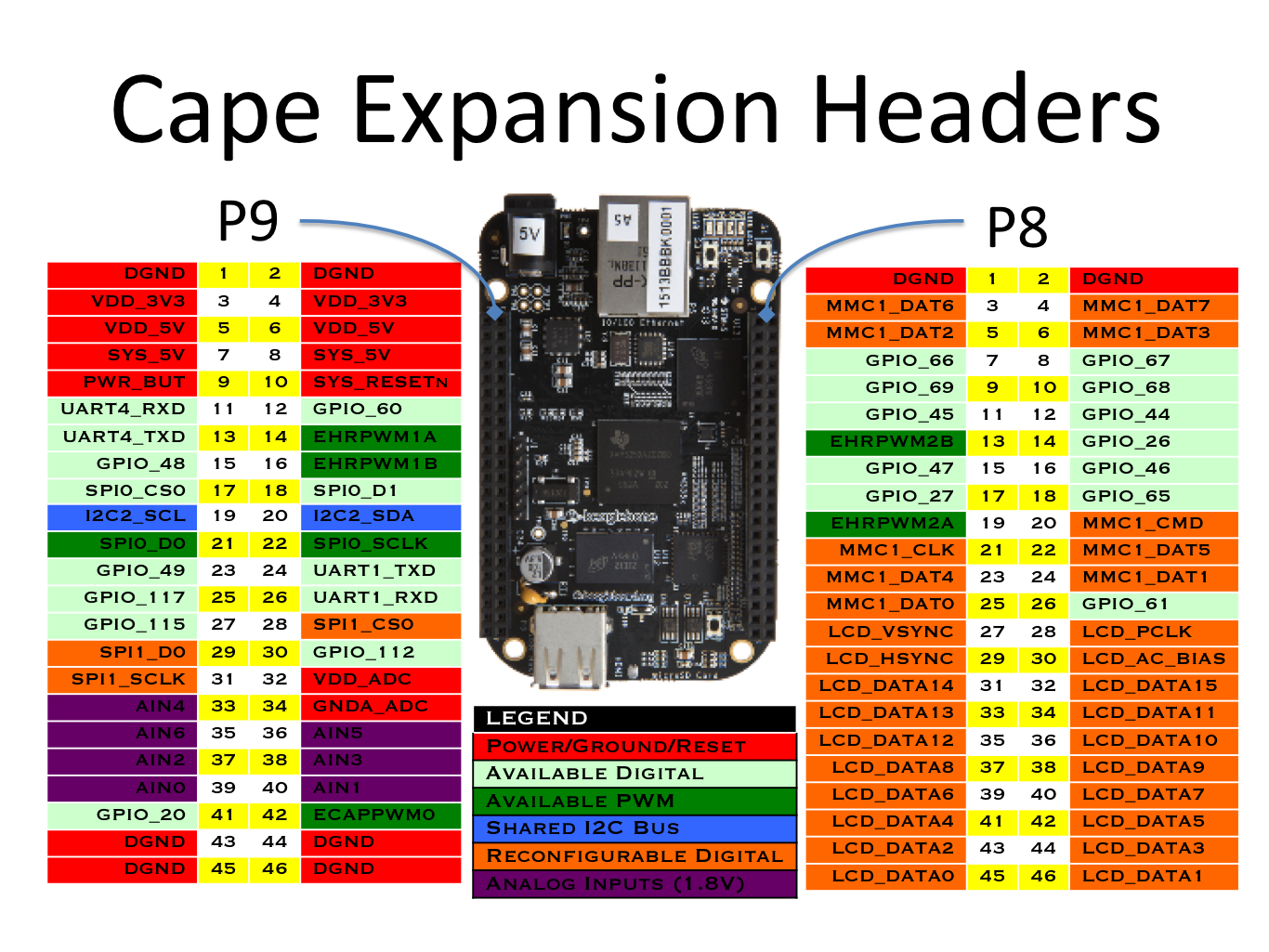
The BeagleBone Black has P8 and P9 headers [0] which expose many of the
AM3358 ZCZ SoC balls to stacking expansion boards called "capes", or to
other external connections like jumper wires connected to a breadboard.
BeagleBone users will often refer to the "Cape Exanpsion Headers" pin
diagram [1] as it is in the "Bone101" getting started tutorial. [2]

Most of the P8 and P9 header pins can muxed to a GPIO line.  The
gpio-line-names describe which P8 or P9 pin that line goes to and the
default mux for that P8 or P9 pin if it is not GPIO.

For example, gpiochip 1 line 0 is connected to P8 header pin 25 (P8_25)
however the default device tree has the corresponding BGA ball (ZCZ U7)
muxed to mmc1_dat0 as it is used for the on-board eMMC chip.  For that
GPIO line to be used, one would need to modify the device tree to
disable the eMMC and change the pin mux for that ball to GPIO mode.

Some of the AM3358 ZCZ balls corresponding to GPIO lines are not routed
to a P8 or P9 header, but are instead wired to some peripheral device
like on-board eMMC, HDMI framer IC, or status LEDs.  Those names are in
brackets to denote those GPIO lines can not be used.

Some GPIO lines are named "[NC]" as the corresponding balls are not
routed to anything on the PCB.

The goal for these names is to make it easier for a user viewing the
output of gpioinfo to determine which P8 or P9 pin is connected to a
GPIO line.  The output of gpioinfo on a BeagleBone Black would be:

gpiochip0 - 32 lines:
	line   0: "[ethernet]"       unused   input  active-high
	line   1: "[ethernet]"       unused   input  active-high
	line   2: "P9_22 [spi0_sclk]" unused input active-high
	line   3: "P9_21 [spi0_d0]" unused input active-high
	line   4: "P9_18 [spi0_d1]" unused input active-high
	line   5: "P9_17 [spi0_cs0]" unused input active-high
	line   6:  "[sd card]"         "cd"   input   active-low [used]
	line   7: "P9_42A [ecappwm0]" unused input active-high
	line   8: "P8_35 [hdmi]" unused input active-high
	line   9: "P8_33 [hdmi]" unused input active-high
	line  10: "P8_31 [hdmi]" unused input active-high
	line  11: "P8_32 [hdmi]" unused input active-high
	line  12: "P9_20 [i2c2_sda]" unused input active-high
	line  13: "P9_19 [i2c2_scl]" unused input active-high
	line  14: "P9_26 [uart1_rxd]" unused input active-high
	line  15: "P9_24 [uart1_txd]" unused input active-high
	line  16: "[ethernet]"       unused   input  active-high
	line  17: "[ethernet]"       unused   input  active-high
	line  18:      "[usb]"       unused   input  active-high
	line  19:     "[hdmi]"       unused   input  active-high
	line  20:     "P9_41B"       unused   input  active-high
	line  21: "[ethernet]"       unused   input  active-high
	line  22: "P8_19 [ehrpwm2a]" unused input active-high
	line  23: "P8_13 [ehrpwm2b]" unused input active-high
	line  24:       "[NC]"       unused   input  active-high
	line  25:       "[NC]"       unused   input  active-high
	line  26:      "P8_14"       unused   input  active-high
	line  27:      "P8_17"       unused   input  active-high
	line  28: "[ethernet]"       unused   input  active-high
	line  29: "[ethernet]"       unused   input  active-high
	line  30: "P9_11 [uart4_rxd]" unused input active-high
	line  31: "P9_13 [uart4_txd]" unused input active-high
gpiochip1 - 32 lines:
	line   0: "P8_25 [emmc]" unused input active-high
	line   1:     "[emmc]"       unused   input  active-high
	line   2: "P8_5 [emmc]" unused input active-high
	line   3: "P8_6 [emmc]" unused input active-high
	line   4: "P8_23 [emmc]" unused input active-high
	line   5: "P8_22 [emmc]" unused input active-high
	line   6: "P8_3 [emmc]" unused input active-high
	line   7: "P8_4 [emmc]" unused input active-high
	line   8:       "[NC]"       unused   input  active-high
	line   9:       "[NC]"       unused   input  active-high
	line  10:       "[NC]"       unused   input  active-high
	line  11:       "[NC]"       unused   input  active-high
	line  12:      "P8_12"       unused   input  active-high
	line  13:      "P8_11"       unused   input  active-high
	line  14:      "P8_16"       unused   input  active-high
	line  15:      "P8_15"       unused   input  active-high
	line  16:     "P9_15A"       unused   input  active-high
	line  17:      "P9_23"       unused   input  active-high
	line  18: "P9_14 [ehrpwm1a]" unused input active-high
	line  19: "P9_16 [ehrpwm1b]" unused input active-high
	line  20:     "[emmc]"       unused   input  active-high
	line  21: "[usr0 led]" "beaglebone:green:heartbeat" output active-high [used]
	line  22: "[usr1 led]" "beaglebone:green:mmc0" output active-high [used]
	line  23: "[usr2 led]" "beaglebone:green:usr2" output active-high [used]
	line  24: "[usr3 led]" "beaglebone:green:usr3" output active-high [used]
	line  25:     "[hdmi]"  "interrupt"   input  active-high [used]
	line  26:      "[usb]"       unused   input  active-high
	line  27: "[hdmi audio]" "enable" output active-high [used]
	line  28:      "P9_12"       unused   input  active-high
	line  29:      "P8_26"       unused   input  active-high
	line  30: "P8_21 [emmc]" unused input active-high
	line  31: "P8_20 [emmc]" unused input active-high
gpiochip2 - 32 lines:
	line   0:     "P9_15B"       unused   input  active-high
	line   1:      "P8_18"       unused   input  active-high
	line   2:       "P8_7"       unused   input  active-high
	line   3:       "P8_8"       unused   input  active-high
	line   4:      "P8_10"       unused   input  active-high
	line   5:       "P8_9"       unused   input  active-high
	line   6: "P8_45 [hdmi]" unused input active-high
	line   7: "P8_46 [hdmi]" unused input active-high
	line   8: "P8_43 [hdmi]" unused input active-high
	line   9: "P8_44 [hdmi]" unused input active-high
	line  10: "P8_41 [hdmi]" unused input active-high
	line  11: "P8_42 [hdmi]" unused input active-high
	line  12: "P8_39 [hdmi]" unused input active-high
	line  13: "P8_40 [hdmi]" unused input active-high
	line  14: "P8_37 [hdmi]" unused input active-high
	line  15: "P8_38 [hdmi]" unused input active-high
	line  16: "P8_36 [hdmi]" unused input active-high
	line  17: "P8_34 [hdmi]" unused input active-high
	line  18: "[ethernet]"       unused   input  active-high
	line  19: "[ethernet]"       unused   input  active-high
	line  20: "[ethernet]"       unused   input  active-high
	line  21: "[ethernet]"       unused   input  active-high
	line  22: "P8_27 [hdmi]" unused input active-high
	line  23: "P8_29 [hdmi]" unused input active-high
	line  24: "P8_28 [hdmi]" unused input active-high
	line  25: "P8_30 [hdmi]" unused input active-high
	line  26:     "[emmc]"       unused   input  active-high
	line  27:     "[emmc]"       unused   input  active-high
	line  28:     "[emmc]"       unused   input  active-high
	line  29:     "[emmc]"       unused   input  active-high
	line  30:     "[emmc]"       unused   input  active-high
	line  31:     "[emmc]"       unused   input  active-high
gpiochip3 - 32 lines:
	line   0: "[ethernet]"       unused   input  active-high
	line   1: "[ethernet]"       unused   input  active-high
	line   2: "[ethernet]"       unused   input  active-high
	line   3: "[ethernet]"       unused   input  active-high
	line   4: "[ethernet]"       unused   input  active-high
	line   5:     "[i2c0]"       unused   input  active-high
	line   6:     "[i2c0]"       unused   input  active-high
	line   7:      "[emu]"       unused   input  active-high
	line   8:      "[emu]"       unused   input  active-high
	line   9: "[ethernet]"       unused   input  active-high
	line  10: "[ethernet]"       unused   input  active-high
	line  11:       "[NC]"       unused   input  active-high
	line  12:       "[NC]"       unused   input  active-high
	line  13:      "[usb]"       unused   input  active-high
	line  14: "P9_31 [spi1_sclk]" unused input active-high
	line  15: "P9_29 [spi1_d0]" unused input active-high
	line  16: "P9_30 [spi1_d1]" unused input active-high
	line  17: "P9_28 [spi1_cs0]" unused input active-high
	line  18: "P9_42B [ecappwm0]" unused input active-high
	line  19:      "P9_27"       unused   input  active-high
	line  20:     "P9_41A"       unused   input  active-high
	line  21:      "P9_25"       unused   input  active-high
	line  22:       "[NC]"       unused   input  active-high
	line  23:       "[NC]"       unused   input  active-high
	line  24:       "[NC]"       unused   input  active-high
	line  25:       "[NC]"       unused   input  active-high
	line  26:       "[NC]"       unused   input  active-high
	line  27:       "[NC]"       unused   input  active-high
	line  28:       "[NC]"       unused   input  active-high
	line  29:       "[NC]"       unused   input  active-high
	line  30:       "[NC]"       unused   input  active-high
	line  31:       "[NC]"       unused   input  active-high

[0] https://git.io/JfgOd
[1] https://beagleboard.org/capes
[1] https://beagleboard.org/Support/bone101
[2] https://beagleboard.org/static/images/cape-headers.png

Reviewed-by: Jason Kridner <jason@beagleboard.org>
Reviewed-by: Robert Nelson <robertcnelson@gmail.com>
Signed-off-by: Drew Fustini <drew@beagleboard.org>
Signed-off-by: Tony Lindgren <tony@atomide.com>
Add gpio-ranges properties to the gpio controller nodes.

These gpio-ranges were created based on "Table 9-10. CONTROL_MODULE
REGISTERS" in the  "AM335x Technical Reference Manual" [0] and "Table
4-2. Pin Attributes" in the "AM335x Sitara Processor datasheet" [1].
A csv file with this data is available for reference [2].

These mappings are valid for all SoC's that are using am33xx-l4.dtsi.
In addition, the only TI AM33xx parts that actually exist are [0]:
AM3351, AM3352, AM3354, AM3356, AM3357, AM3358, AM3359

These gpio-ranges properties should be added as they describe the
relationship between a gpio line and pin control register that exists
in the hardware.  For example, GPMC_A0 pin has mode 7 which is labeled
gpio1_16. conf_gpmc_a0 register is at offset 840h which makes it pin 16.

[0] https://www.ti.com/lit/ug/spruh73q/spruh73q.pdf
[1] http://www.ti.com/lit/ds/symlink/am3358.pdf
[2] https://gist.github.com/pdp7/6ffaddc8867973c1c3e8612cfaf72020
[3] http://www.ti.com/processors/sitara-arm/am335x-cortex-a8/overview.html

Signed-off-by: Drew Fustini <drew@beagleboard.org>
Signed-off-by: Tony Lindgren <tony@atomide.com>
The IPU and DSP remote processors use sub-mailbox nodes only from a
limited set of System Mailboxes 5 and 6 to achieve the Remote Processor
Messaging (RPMsg) communication stack between the MPU host processor
and the respective remote processor. These are all defined and enabled
through the inherited common dra74-ipu-dsp-common.dtsi file.

The other System Mailboxes do not define any actual sub-mailboxes, so
they serve no purpose and can all be safely dropped.

Signed-off-by: Suman Anna <s-anna@ti.com>
Signed-off-by: Tony Lindgren <tony@atomide.com>
Assign the previously added CMA reserved memory nodes to the respective
IPU and DSP rproc device nodes, and enable these rproc nodes so that
these remote processors can be booted on the AM5729 BeagleBone AI board.

The addresses and sizes of the CMA pools are identical to those used on
various other TI AM572x/AM574x based boards. The mailboxes, timers and
watchdog-timers for all these remoteprocs are inherited by including the
common dra72-ipu-dsp-common.dtsi file.

An associated pair of the rproc node and its CMA node can be disabled
later on if there is no use-case defined to use that remote processor.

Signed-off-by: Suman Anna <s-anna@ti.com>
Signed-off-by: Tony Lindgren <tony@atomide.com>
Fix dtschema validator warnings like:
    l2-cache-controller@48242000: $nodename:0: 'l2-cache-controller@48242000'
        does not match '^(cache-controller|cpu)(@[0-9a-f,]+)*$'

Signed-off-by: Krzysztof Kozlowski <krzk@kernel.org>
Signed-off-by: Tony Lindgren <tony@atomide.com>
Fix dtschema validator warnings like:
    l2-cache-controller@48242000: $nodename:0:
        'l2-cache-controller@48242000' does not match '^(cache-controller|cpu)(@[0-9a-f,]+)*$'

Signed-off-by: Krzysztof Kozlowski <krzk@kernel.org>
Signed-off-by: Tony Lindgren <tony@atomide.com>
Various OMAP3 boards have two AES blocks, but only one is currently
available, because the hwmods are only configured for one.

This patch migrates the hwmods for the AES engine to sysc-omap2
which allows the second AES crypto engine to become available.

  omap-aes 480a6000.aes1: OMAP AES hw accel rev: 2.6
  omap-aes 480a6000.aes1: will run requests pump with realtime priority
  omap-aes 480c5000.aes2: OMAP AES hw accel rev: 2.6
  omap-aes 480c5000.aes2: will run requests pump with realtime priority

Signed-off-by: Adam Ford <aford173@gmail.com>
[tony@atomide.com: updated to disable both aes_targets on hs boards]
Signed-off-by: Tony Lindgren <tony@atomide.com>
Pull ARM OMAP fixes from Arnd Bergmann:
 "The OMAP developers are particularly active at hunting down
  regressions, so this is a separate branch with OMAP specific
  fixes for v5.8:

  As Tony explains
    "The recent display subsystem (DSS) related platform data changes
     caused display related regressions for suspend and resume. Looks
     like I only tested suspend and resume before dropping the legacy
     platform data, and forgot to test it after dropping it. Turns out
     the main issue was that we no longer have platform code calling
     pm_runtime_suspend for DSS like we did for the legacy platform data
     case, and that fix is still being discussed on the dri-devel list
     and will get merged separately. The DSS related testing exposed a
     pile other other display related issues that also need fixing
     though":

   - Fix ti-sysc optional clock handling and reset status checks for
     devices that reset automatically in idle like DSS

   - Ignore ti-sysc clockactivity bit unless separately requested to
     avoid unexpected performance issues

   - Init ti-sysc framedonetv_irq to true and disable for am4

   - Avoid duplicate DSS reset for legacy mode with dts data

   - Remove LCD timings for am4 as they cause warnings now that we're
     using generic panels

  Other OMAP changes from Tony include:

   - Fix omap_prm reset deassert as we still have drivers setting the
     pm_runtime_irq_safe() flag

   - Flush posted write for ti-sysc enable and disable

   - Fix droid4 spi related errors with spi flags

   - Fix am335x USB range and a typo for softreset

   - Fix dra7 timer nodes for clocks for IPU and DSP

   - Drop duplicate mailboxes after mismerge for dra7

   - Prevent pocketgeagle header line signal from accidentally setting
     micro-SD write protection signal by removing the default mux

   - Fix NFSroot flakeyness after resume for duover by switching the
     smsc911x gpio interrupt to back to level sensitive

   - Fix regression for omap4 clockevent source after recent system
     timer changes

   - Yet another ethernet regression fix for the "rgmii" vs "rgmii-rxid"
     phy-mode

   - One patch to convert am3/am4 DT files to use the regular sdhci-omap
     driver instead of the old hsmmc driver, this was meant for the
     merge window but got lost in the process"

* tag 'arm-omap-fixes-5.8-1' of git://git.kernel.org/pub/scm/linux/kernel/git/soc/soc: (21 commits)
  ARM: dts: am5729: beaglebone-ai: fix rgmii phy-mode
  ARM: dts: Fix omap4 system timer source clocks
  ARM: dts: Fix duovero smsc interrupt for suspend
  ARM: dts: am335x-pocketbeagle: Fix mmc0 Write Protect
  Revert "bus: ti-sysc: Increase max softreset wait"
  ARM: dts: am437x-epos-evm: remove lcd timings
  ARM: dts: am437x-gp-evm: remove lcd timings
  ARM: dts: am437x-sk-evm: remove lcd timings
  ARM: dts: dra7-evm-common: Fix duplicate mailbox nodes
  ARM: dts: dra7: Fix timer nodes properly for timer_sys_ck clocks
  ARM: dts: Fix am33xx.dtsi ti,sysc-mask wrong softreset flag
  ARM: dts: Fix am33xx.dtsi USB ranges length
  bus: ti-sysc: Increase max softreset wait
  ARM: OMAP2+: Fix legacy mode dss_reset
  bus: ti-sysc: Fix uninitialized framedonetv_irq
  bus: ti-sysc: Ignore clockactivity unless specified as a quirk
  bus: ti-sysc: Use optional clocks on for enable and wait for softreset bit
  ARM: dts: omap4-droid4: Fix spi configuration and increase rate
  bus: ti-sysc: Flush posted write on enable and disable
  soc: ti: omap-prm: use atomic iopoll instead of sleeping one
  ...
i.MX fixes for 5.8:

- Fix LDO1 and LDO2 voltage range for a couple of i.MX8M board device
  trees.
- Fix i.MX8MP UID fuse offset in i.MX8M SoC driver.
- Fix watchdog configuration in imx6ul-kontron device tree.
- Fix one build warning seen on building soc-imx8m driver with
  x86_64-randconfig.
- Add missing put_device() call for a couple of mach-imx PM functions.

* tag 'imx-fixes-5.8' of git://git.kernel.org/pub/scm/linux/kernel/git/shawnguo/linux:
  soc: imx8m: fix build warning
  ARM: imx6: add missing put_device() call in imx6q_suspend_init()
  ARM: imx5: add missing put_device() call in imx_suspend_alloc_ocram()
  soc: imx8m: Correct i.MX8MP UID fuse offset
  ARM: dts: imx6ul-kontron: Change WDOG_ANY signal from push-pull to open-drain
  ARM: dts: imx6ul-kontron: Move watchdog from Kontron i.MX6UL/ULL board to SoM
  arm64: dts: imx8mm-beacon: Fix voltages on LDO1 and LDO2
  arm64: dts: imx8mn-ddr4-evk: correct ldo1/ldo2 voltage range
  arm64: dts: imx8mm-evk: correct ldo1/ldo2 voltage range

Link: https://lore.kernel.org/r/20200624111725.GA24312@dragon
Signed-off-by: Arnd Bergmann <arnd@arndb.de>
This pull request contains Broadcom ARM-based SoCs Device Tree fixes for
5.8, please pull the following:

- Rafal adds a missing 'device_type' property to the Luxul XWC-2000
  required for the memory nodes to be correctly parsed by Linux

- Matthew provides two fixes for the NSP SoCs, one to disable the PL330
  DMA controller by default since it can be left in reset by the
  bootloader and the second to correct the flow accelerator mailbox node

* tag 'arm-soc/for-5.8/devicetree-fixes' of https://github.com/Broadcom/stblinux:
  ARM: dts: NSP: Correct FA2 mailbox node
  ARM: dts: NSP: Disable PL330 by default, add dma-coherent property
  ARM: dts: BCM5301X: Add missing memory "device_type" for Luxul XWC-2000

Link: https://lore.kernel.org/r/20200619202250.19029-1-f.fainelli@gmail.com
Signed-off-by: Arnd Bergmann <arnd@arndb.de>
Few dts fixes for omaps for v5.8

Few fixes for various devices:

- Prevent pocketgeagle header line signal from accidentally setting
  micro-SD write protection signal by removing the default mux

- Fix NFSroot flakeyness after resume for duover by switching the
  smsc911x gpio interrupt to back to level sensitive

- Fix regression for omap4 clockevent source after recent system
  timer changes

- Yet another ethernet regression fix for the "rgmii" vs "rgmii-rxid"
  phy-mode

* tag 'omap-for-v5.8/fixes-rc1-signed' of git://git.kernel.org/pub/scm/linux/kernel/git/tmlind/linux-omap:
  ARM: dts: am5729: beaglebone-ai: fix rgmii phy-mode
  ARM: dts: Fix omap4 system timer source clocks
  ARM: dts: Fix duovero smsc interrupt for suspend
  ARM: dts: am335x-pocketbeagle: Fix mmc0 Write Protect

Link: https://lore.kernel.org/r/pull-1592499282-121092@atomide.com
Signed-off-by: Arnd Bergmann <arnd@arndb.de>
Missed sdhci patch for am3 and am4

I forgot to send a pull request earlier for converting am3 and am4 to
use sdhci-omap driver instead of the old omap_hsmmc driver.

There was a display subsystem related suspend and resume regression found
recently and looks like I forgot to send a pull request for this patch
while debugging the regression. This patch has been tested without the
display subsystem, and has been in Linux next for several weeks now, so
would be good to have merged for v5.8.

* tag 'omap-for-v5.8/dt-missed-signed' of git://git.kernel.org/pub/scm/linux/kernel/git/tmlind/linux-omap:
  ARM: dts: Move am33xx and am43xx mmc nodes to sdhci-omap driver

Link: https://lore.kernel.org/r/pull-1591637467-607254@atomide.com
Signed-off-by: Arnd Bergmann <arnd@arndb.de>
Fixes for omaps for v5.8

The recent display subsystem (DSS) related platform data changes caused
display related regressions for suspend and resume. Looks like I only
tested suspend and resume before dropping the legacy platform data, and
forgot to test it after dropping it. Turns out the main issue was that
we no longer have platform code calling pm_runtime_suspend for DSS like
we did for the legacy platform data case, and that fix is still being
discussed on the dri-devel list and will get merged separately. The DSS
related testing exposed a pile other other display related issues that
also need fixing though:

- Fix ti-sysc optional clock handling and reset status checks
  for devices that reset automatically in idle like DSS

- Ignore ti-sysc clockactivity bit unless separately requested
  to avoid unexpected performance issues

- Init ti-sysc framedonetv_irq to true and disable for am4

- Avoid duplicate DSS reset for legacy mode with dts data

- Remove LCD timings for am4 as they cause warnings now that we're
  using generic panels

Then there is a pile of other fixes not related to the DSS:

- Fix omap_prm reset deassert as we still have drivers setting the
  pm_runtime_irq_safe() flag

- Flush posted write for ti-sysc enable and disable

- Fix droid4 spi related errors with spi flags

- Fix am335x USB range and a typo for softreset

- Fix dra7 timer nodes for clocks for IPU and DSP

- Drop duplicate mailboxes after mismerge for dra7

* tag 'omap-for-v5.8/fixes-merge-window-signed' of git://git.kernel.org/pub/scm/linux/kernel/git/tmlind/linux-omap:
  Revert "bus: ti-sysc: Increase max softreset wait"
  ARM: dts: am437x-epos-evm: remove lcd timings
  ARM: dts: am437x-gp-evm: remove lcd timings
  ARM: dts: am437x-sk-evm: remove lcd timings
  ARM: dts: dra7-evm-common: Fix duplicate mailbox nodes
  ARM: dts: dra7: Fix timer nodes properly for timer_sys_ck clocks
  ARM: dts: Fix am33xx.dtsi ti,sysc-mask wrong softreset flag
  ARM: dts: Fix am33xx.dtsi USB ranges length
  bus: ti-sysc: Increase max softreset wait
  ARM: OMAP2+: Fix legacy mode dss_reset
  bus: ti-sysc: Fix uninitialized framedonetv_irq
  bus: ti-sysc: Ignore clockactivity unless specified as a quirk
  bus: ti-sysc: Use optional clocks on for enable and wait for softreset bit
  ARM: dts: omap4-droid4: Fix spi configuration and increase rate
  bus: ti-sysc: Flush posted write on enable and disable
  soc: ti: omap-prm: use atomic iopoll instead of sleeping one

Link: https://lore.kernel.org/r/pull-1591889257-410830@atomide.com
Signed-off-by: Arnd Bergmann <arnd@arndb.de>
ARMv8 Juno/Vexpress/Fast Models fix for v5.8

Partial revert of some recent fixes to silence DTC warning which broke
clocks on some Vexpress platforms resulting in boot issues.

* tag 'juno-fix-5.8' of git://git.kernel.org/pub/scm/linux/kernel/git/sudeep.holla/linux:
  arm: dts: vexpress: Move mcc node back into motherboard node

Link: https://lore.kernel.org/r/20200609180447.GB5732@bogus
Signed-off-by: Arnd Bergmann <arnd@arndb.de>
Fix dtschema warning message by changing nodename to 'cache-controller':

    DT_SCHEMA_FILES=Documentation/devicetree/bindings/arm/l2c2x0.yaml
    arch/arm/boot/dts/exynos4210-i9100.dt.yaml: l2-cache-controller@10502000:
	$nodename:0: 'l2-cache-controller@10502000' does not match '
	^(cache-controller|cpu)(@[0-9a-f,]+)*$'

Signed-off-by: Anand Moon <linux.amoon@gmail.com>
Signed-off-by: Krzysztof Kozlowski <krzk@kernel.org>
The SDHCI on Tegra30 is in fact not backwards-compatible with the
instantiation found on earlier SoCs. Drop the misleading compatible
string.

Signed-off-by: Thierry Reding <treding@nvidia.com>
The display controller on Tegra30 is in fact not backwards-compatible
with the instantiation found on earlier SoCs. Drop the misleading
compatible string.

Signed-off-by: Thierry Reding <treding@nvidia.com>
The DSI output needs to specify a parent clock that will be used to
drive both the output and the display controller.

Signed-off-by: Thierry Reding <treding@nvidia.com>
Seaboard uses a non-existing, possibly obsoleted, binding for the
battery. Move to the standard binding which seems to be a super-
set of the odl binding.

Signed-off-by: Thierry Reding <treding@nvidia.com>
Unit-addresses should be numeric. This fixes a validation failure seen
using the json-schema tooling.

Signed-off-by: Thierry Reding <treding@nvidia.com>
Simple panels can only have a single power supply. The second listed
supply is not needed because it is also the input supply of the first
supply and therefore will always be on at the same time.

In retrospect the panel probably doesn't qualify as simple since it
apparently does need both of these supplies, even if in the case of the
Medcom Wide it isn't necessary to explicitly hook them up.

Signed-off-by: Thierry Reding <treding@nvidia.com>
Use commas rather than underscores to separate the various parts of the
unit-address in CPU OPPs to make them properly validate under the json-
schema bindings.

Signed-off-by: Thierry Reding <treding@nvidia.com>
This is purely to make the json-schema validation tools happy because
they cannot deal with string arrays that may be in arbitrary order.

Signed-off-by: Thierry Reding <treding@nvidia.com>
The memory controller exposes a set of memory client resets and needs to
specify the #reset-cells property in order to advertise the number of
cells needed to describe each of the resets.

Signed-off-by: Thierry Reding <treding@nvidia.com>
Tuple boundaries should be marked by < and > to make it clear which
cells are part of the same tuple. This also helps the json-schema based
validation tooling to properly parse this data.

While at it, also remove the "immovable" bit from PCI addresses. All of
these addresses are in fact "movable".

Cc: Marcel Ziswiler <marcel.ziswiler@toradex.com>
Cc: Philippe Schenker <philippe.schenker@toradex.com>
Signed-off-by: Thierry Reding <treding@nvidia.com>